


SKU:PZN 03173043
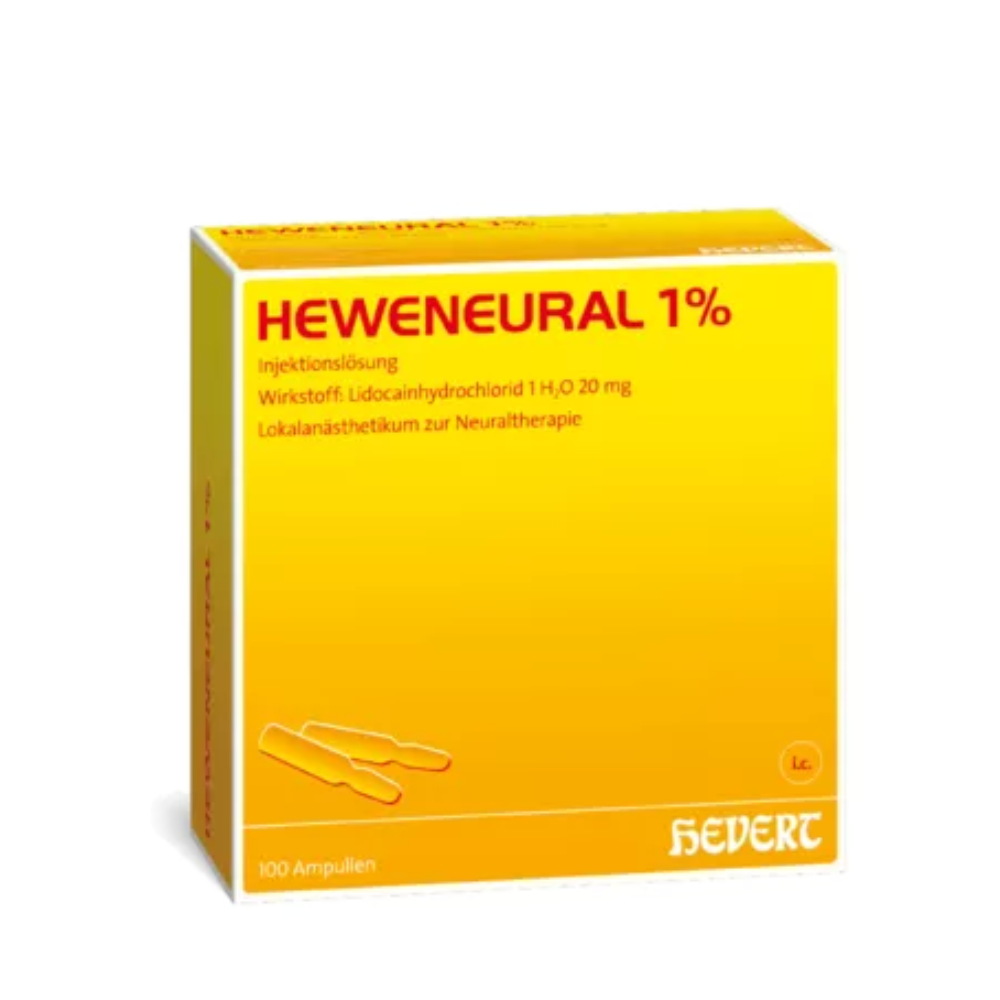
Heweneural 1%
Couldn't load pickup availability
Description
Heweneural 1% is a local anesthetic containing lidocaine, used in neural therapy by trained practitioners. Neural therapy involves injections into specific skin segments (Head’s zones) to influence internal organs via the nervous system. It also targets interference fields caused by chronic inflammation. Heweneural 1% supports both segmental and interference field therapy and should only be used by professionals experienced in neural therapy.
Ingredients
- Lidocain-HCl

Heweneural 1%
Neural therapy
with Heweneural 1%
Neural therapy consists of segmental therapy and interference field therapy. Segmental therapy is based on the assumption that the internal organs correspond to specific segments of the skin (dermatomes) and are connected with them via nerves (Head’s zones). The attending doctor or natural practitioner injects a local anesthetic (e.g. procaine or lidocaine) into the skin and reaches the corresponding organ via the nerve. This frequently gives rise to small protrusions known as wheals. That is why neural therapy is often also referred to as wheal therapy. The aim of neural therapy is to attain an effect in the affected segment via the autonomic nervous system.
In interference field therapy, “interference fields” triggered by chronic inflammations are treated. Interference fields are believed to weaken the entire body and can cause symptoms in other areas of the body. The most common interference fields can be found in the tonsils, the sinuses, the tooth/jaw region, the thyroid, and in scars, although any site in the body can actually become an interference field. Treatment with Hewedolor Procain 2% should be carried out by a natural practitioner or doctor with experience in neural therapy.
Heweneural 1% contains lidocaine and is a local anesthetic for neural therapy.
- Contraindications
- Adverse Effects
- Recommended use
- Mandatory information
- Allergy to amide-type local anesthetics (e.g. Lidocaine)
- Severe cardiac conduction disorders
-Acute heart failure, shock
Do not inject into inflamed tissue
⚠️ Use with caution:
- Liver/kidney dysfunction
- Myasthenia gravis
- Head/neck injections
Concurrent use of anticoagulants, NSAIDs, or plasma expanders
During pregnancy – only if strictly indicated
Systemic reactions at high blood levels:
- CNS: restlessness, dizziness, seizures
- Cardiovascular: hypotension, arrhythmia
Allergic reactions:
Rash, itching, edema, bronchospasm, shortness of breath, anaphylaxis
Rare: Malignant hyperthermia
High-dose use: Risk of Lidocaine toxicity, especially with cumulative effect
- For neural therapeutic applications
(e.g. Quaddel therapy, segment therapy, scar injection, trigger points)
- Used to modulate nerve activity and treat pain or functional disorders in the autonomic nervous system
- Based on the principles of Hunecke neural therapy
Each ampoule (2 ml) contains:
20 mg Lidocaine HCl × H₂O (≈ 16.2 mg Lidocaine base)
Sodium chloride, water for injection, NaOH for pH adjustment
Storage: Keep below 25 °C, protect from light
Alcohol content: None